Seminar; Beginning Phase 2
- Georgia Brechelt

- Sep 19, 2019
- 5 min read




Slide 1:
Initial Concept (Phase 1): A Conscious Surface
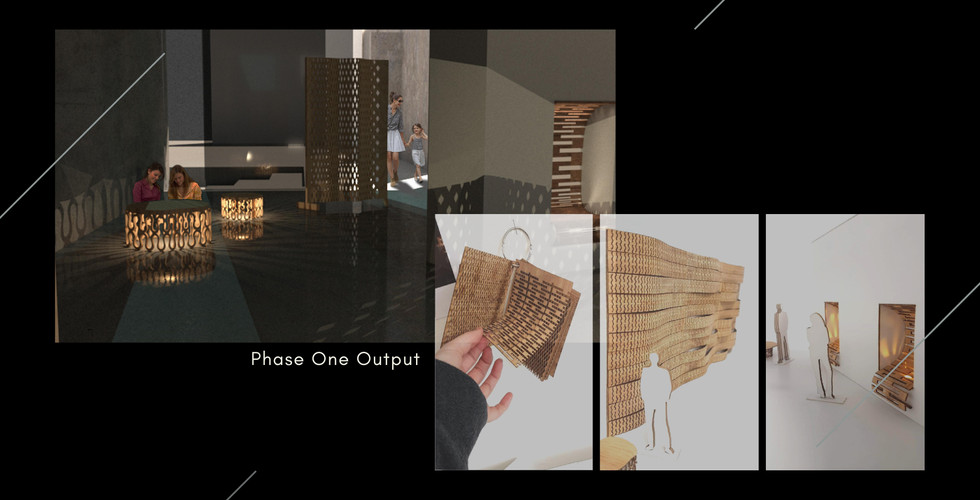
Our design ‘A Conscious Surface’ intends to speaks for itself, and inhabit others while being inhabited. We redesigned the gallery space on St Pauls Street based on a ‘living’ concept. We wanted to create a moving, breathing space, and aimed to do so by creating moments which were, private, refined and intimate, where visitors could contemplate and consider the space and its inhabitants.
Slide 2:
What was the identified gap?
After visiting different galleries around Auckland, we noticed a common theme, a lack of inhabiting, people within galleries stand back, try to stay out of the way, and often rush through the space without contemplation, without ‘living’ and ‘breathing’ in the space. This led us to question ‘What does it mean to be alive/to live?”After research, testing materiality and brainstorming, we came to the conclusion that living and breathing is all about movement and airflow. I also considered the way humans behave in and out of light, and how different lighting influences our activity or lack there-of.
Slide 3:
What does it mean to be alive?
The design pivoted around a series of installations, temporal and permanent structures to provide private, breathable moments. These were based around the concept of the ‘living hinge’, a technique used in plywood to create flexibility and movement. We wanted visitors to interact and move the space around, as well as filtering the natural light into the gallery through hinge-screens. Looking at our final design, I think our concept is interesting as a method of gaining engagement within the space, however some of our designs don’t articulate our initial breathing, living, concept as clearly as we had hoped.
Slide 4:
How could I manifest my ‘living, breathing’ concept into a pavilion (Phase 2):
Moving in to Phase two, I have decided to design a pavilion space. Prioritising my concept over physical design, I reflected on our durational map from phase 1. By witnessing a lack of activity in certain spaces, I considered how to utilise these spaces to encourage more interaction with the site. Realising movement within a space is key in creating a ‘breathing’ space or space to breathe, can further inspire my decision making in creating a pavilion which encourages breathing, contemplation and time out. As our external activities aren’t what justifies ‘living’, our thoughts and emotions are, so by providing an oasis for this internal activity to occur answers my desire of a design that is living.
Slide 5:
Inside, Outside, and inside out (Reading 1)
“The significance of the inside, the space of human inhabitation, the space that is more felt than seen”.
The concepts discussed in Inside, Outside and Inside Out, bring to light the separation between the outside and inside. The text elaborates on how “inside we are occupants; outside we are spectators” and that “the world becomes something out there, external to oneself - visible, measurable, and reported by others”. The inside is experienced and encountered whereas the outside, is separate from one's-self and does not allow for genuine inhabitation or a connection with our internal thoughts and feelings. The text also refers to my first design precedent and how her modes of designing compete with this notion (Architecture Inside Out, 2000).3
Slide 6:
Activation of publicness (Design precedent 1)
Rachel Whiteread explores the relationship that people have with public and private spaces, and creates a sense of discomfort in forcing the inside, out with her abstract architectural design on the London terrace house.
The idea of flipping the public’s sense of public and private is very provocative and I think ties in well with creating breathing space, which can be seen as a wide open space filled with oxygen, or alternatively as a quiet small corner or escape from the wide open city landscape and its bustling crowds. Both perspectives apply a sense of public or private and I would find it interesting to explore the sense of experiencing privacy in a public space, where contemplation and encounter comes freely (Rachel Whitehead, House).4&5
Slide 7:
A Halt in the City (Reading 2)
“Slow places are often experienced as temporary halts in a city, as breathing spaces; they offer moments of silence and encounters. These experiences suggest the sense of time is both inter-subjective and location-specific- and also, sensory and meaningful. In cities, time is experienced and performed collectively; it is jointly perceived and shared.”(Journal of Urban Design, 2013)
This text discusses the chaos of the city and pockets of calm, and how these moments and encounters of quiet enforce contemplation about our sense of time, and encourages a collective and communal experience.6
Slide 8:
How can I portray movement within a stable pavilion structure?
In phase one, we utilised the living hinge concept to create movement and flexibility within our material choices. While exploring other forms of causing malleability and its uses in architecture, I was inspired by the idea of origami, stemming from the ‘paper’ pavilion brief I wondered how I could challenge this and myself by working with designs which began from a paper origin, such as origami. I was really drawn to the notion of folding as a verb, and a motion, and wanted to refine how a legitimately paper-crafted pavilion could translate to a dynamic, breathing pavilion which encourages contemplation and sensory engagement, and possibly questions the publicness of St Pauls street.
Slide 9 & 10:
Kinematic Sculpture (Design Precedent 2)
After researching origami inspired architecture and temporal installation, I discovered the ‘Kinematic Sculpture’ by Skidmore, Owings & Merrill LLP, I love the dynamic element and how it identifies compression and expansion in one motion which is adjustable by the viewer. The technical elements of this design are fascinating, as well as their design process, where they began by working with paper models, and gradually scaling up and adjusting their design, before realising the final 1:1 scale project and its potential. This design precedent is extremely influential to my work technically as well as to my design process, and encourages me to continue with my ‘paper’ drafting and crafting in order to experiment with movement and expansion/compression, indulging in a battle between public and private.11, 12, 13, & 14
Seminar Figure List/Citing:
The Māori Portraits: Gottfried Lindauer’s New Zealand ..photograph, Auckland. Retrieved from https://fashionwall.online/current-mortgage-and-refinance-rates/
Davis, C. St Paul's Street Parklet Polka Dots. photograph, Auckland. Retrieved from https://www.activateakl.work/st-paul-street-parklets-polka-dots
Franck, K. A., & Lepori, R. B. (2000). Inside, Outside and Inside-Out. In Architecture Inside Out(pp. 10–13). Wiley.
Baker, R. (2018). Rachel Whitehead, House. photograph, East London. Retrieved from https://www.artsy.net/article/artsy-editorial-rachel-whitereads-house-unlivable-controversial-unforgettable
Omerod, S. (2018). Rachel Whiteread, House. photograph, London. Retrieved from https://www.artsy.net/article/artsy-editorial-rachel-whitereads-house-unlivable-controversial-unforgettable
Wunderlich, F. M., & . (2013). Place-Temporality and Urban Place-Rhythyms in Urban Analysis and Design: An Aesthetic Akin to Music. In Journal of Urban Design(Vol. 18:3). Taylor and Francis.
Sweeney, R. 02. photograph, London. Retrieved from https://www.flickr.com/photos/richardsweeney/2089901064/in/photostream
Sweeney, R. Motion Pleat. photograph, London. Retrieved from https://www.flickr.com/photos/richardsweeney/4378914623/
Lamere, J. Pleated Shape. photograph. Retrieved from https://www.flickr.com/photos/jdlamere/185788894/in/photostream/
Lamere, J. Serialized "pinch". photograph. Retrieved from https://www.flickr.com/photos/jdlamere/185782559/in/photostream/
(11, 12, 13, 14) Baldwin, E. Som Designs Kinematic Sculpture. photograph, Chicago. Retrieved from https://www.archdaily.com/904506/som-designs-kinematic-sculpture-for-chicago-design-week/5bcf0227f197cc210f0000e5-som-designs-kinematic-sculpture-for-chicago-design-week-photo
-All other photographs, drawings and renders were produced and photographed myself in July and August 2019.


Comments