Phase 2, Moving forward
- Georgia Brechelt

- Oct 2, 2019
- 5 min read







Slide 1 & 2:
In phase one, we utilised the living hinge concept to create a sense of movement and flexibility within our material choices. This was a decision made to address our desire for a living breathing space, where we wanted to physically explore the elements that make up living, which we defined movement to be a large part of this, as well as circulation through breathing. While exploring other forms of causing malleability and its uses in architecture, I was inspired by the folds and pleats of origami, stemming from the ‘paper’ pavilion brief I wondered how I could challenge this and myself by working with designs which began from a paper origin, such as origami. I was really drawn to the notion of folding as a verb, and a motion, and wanted to refine how a legitimately paper-crafted pavilion could translate to a dynamic, breathing pavilion which encourages contemplation and sensory engagement, and possibly questions the publicness of St Pauls street.
Slide 3:
Fold Bend Twist
After considering the folding/pleating dynamic of origami aesthetically, I began to explore how the folding, bending, twisting visuals can be used in architecture and how pavilions have been inspired by some of this imagery. As I began to look further into this idea I realised I was more concerned about the aesthetics as opposed to the experience of inhabiting the space, and how people can physically flow through the space, or use the pavilion as a breathing space as I was originally aiming for. So I began to consider what it means to have “Breathing Space”.
Slide 4:
Breathing space
The idea of creating a breathing space, stemmed from the sensations we experience within the big city, versus how we interact within a gallery space and the way we behave in private, interior spaces. Breathing space can mean two opposing things, for one breathing space can be interpreted as an open air allowing someone ease of inhalation without restriction, on the other hand it can be seen as a moment of privacy, a break from whatever else is happening around you. In Auckland City, where AUT is based, the space is bustling, active and exposed. So within this setting, if I consider what breathing space means to me, i imagine somewhere I can remove myself from the public eye. Take a breathe without the person beside me hearing, where I can be in my own company and not require the facade of my urbanised self to conform. So I would like to incorporate a sense of privacy, with the option of movement through and within the space, by designing a pavilion which potential limits the community within to cultivate more substantial, intimate, genuine interactions and thoughts with oneself and others within the small designed community.
Slide 5:
Inside, Outside, and inside out (Reading)
“The significance of the inside, the space of human inhabitation, the space that is more felt than seen”.
The concepts discussed in Inside, Outside and Inside Out, bring to light the separation between the outside and inside. The text elaborates on how “inside we are occupants; outside we are spectators” and that “the world becomes something out there, external to oneself - visible, measurable, and reported by others”. The inside is experienced and encountered whereas the outside, is separate from one's-self and does not allow for genuine inhabitation or a connection with our internal thoughts and feelings. The text also refers to Rachel Whiteread and how her modes of designing compete with this notion (Architecture Inside Out, 2000).3
Slide 6:
Activation of publicness (Rachel Whiteread)
Rachel Whiteread explores the relationship that people have with public and private spaces, and creates a sense of discomfort in forcing the inside, out with her abstract architectural design on the London terrace house.
The idea of flipping the public’s sense of public and private is very provocative and I think ties in well with creating breathing space, which can be seen as a wide open space filled with oxygen, or alternatively as a quiet small corner or escape from the wide open city landscape and its bustling crowds. Both perspectives apply a sense of public or private and I would find it interesting to explore the sense of experiencing privacy in a public space, where contemplation and encounter comes freely (Rachel Whitehead, House).4&5
Slide 7:
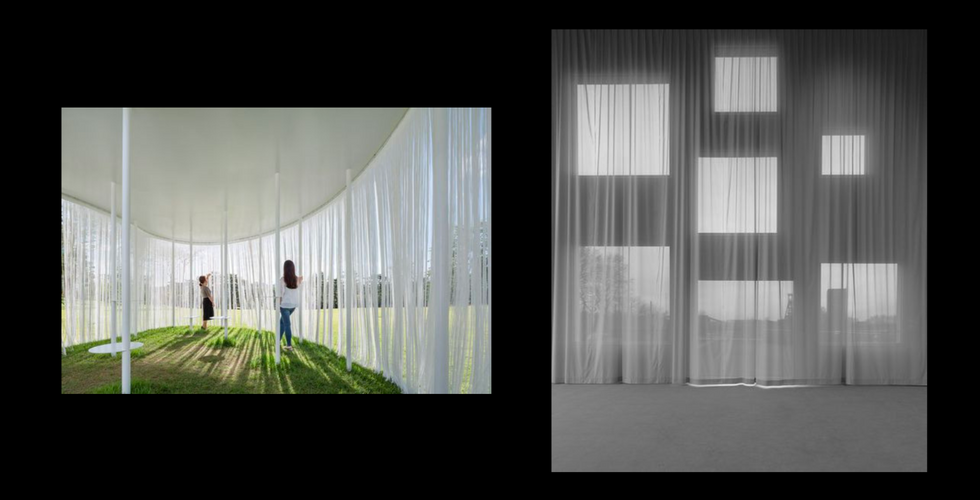
After exploring the inside out text as well as Rachel Whiteheads house installation, I really aim to focus my design on toying with the idea of inside and outside, and how humans interact within interior and exterior spaces, and what specifications make a difference to this experience and the public relations with themselves. I am considering how altering visibility within an exterior space could potentially create an interior experience, by creating more privacy. Especially depending on the material used, for example in these images, fabric and cloth is used to obscure visibility between the space, and its exterior, however fabrics are very rarely used outdoors and people make a home-like connection to linens and clothes because they are something we use in everyday life indoors, so it gives the interior of the space more of a personal feel as opposed to if glass were to be used.
Slide 8:
A Halt in the City (Reading)
“Slow places are often experienced as temporary halts in a city, as breathing spaces; they offer moments of silence and encounters. These experiences suggest the sense of time is both inter-subjective and location-specific- and also, sensory and meaningful. In cities, time is experienced and performed collectively; it is jointly perceived and shared.”(Journal of Urban Design, 2013)
This text discusses the chaos of the city and pockets of calm, and how these moments and encounters of quiet enforce contemplation about our sense of time, and encourages a collective and communal experience.6
This design precedent is extremely influential to my work technically as well as to my design process, and encourages me to continue with my ‘paper’ drafting and crafting in order to experiment with movement and expansion/compression, indulging in a battle between public and private.11, 12, 13, & 14
Slides 9 &10
Expanding further on the idea of movement within a space, and creating breathing space. I have studied the idea that in order to experience breathing space you have to be comfortable, and at your chosen level of privacy. Because of this my pavilion design will be an adaptable space, entirely dictated by the small community within. I want public that need “a breather” or some time out and space for contemplation, to be able to feel like they have created a safe breathing space for themselves, and made it their own.
So through looking at folding, twisting movements inspired by my interest in origami forms, as well as flow throughout space, I have come up with the idea of using shutter systems or pivoting doors/windows which allows the inhabitants of the pavilion to alter the privacy of the site, and how much flow they want between the outside world and their small breathing space. Therefore being able to limit and confine the pavilion or open it up to the public providing more air and light flow, similarly to the “moving landscapes” house by Matharoo Associates where the facade of the structure animates to reveal the interior, through sliding and twisting.
I am currently In the stages of designing the structure and its size, the pavilion doesn't need to be large as it creates a small intimate community within, and with the users being able to open up or close the space off, it enlarges or encapsulates it depending on the wants of the public.
Moving forward I am considering how I might create smaller spaces within the pavilion which can also be adapted and controlled, providing movement, adaptability and people flow through the entrance to the art gallery.
References:
Franck, K. A., & Lepori, R. B. (2000). Inside, Outside and Inside-Out. In Architecture Inside Out(pp. 10–13). Wiley.
Baker, R. (2018). Rachel Whitehead, House. photograph, East London. Retrieved from https://www.artsy.net/article/artsy-editorial-rachel-whitereads-house-unlivable-controversial-unforgettable
Omerod, S. (2018). Rachel Whiteread, House. photograph, London. Retrieved from https://www.artsy.net/article/artsy-editorial-rachel-whitereads-house-unlivable-controversial-unforgettable
Wunderlich, F. M., & . (2013). Place-Temporality and Urban Place-Rhythyms in Urban Analysis and Design: An Aesthetic Akin to Music. In Journal of Urban Design(Vol. 18:3). Taylor and Francis.
Frearson, A. (2016, July 11). Spinning walls animate the facade of Indian house by Matharoo. Retrieved from https://www.dezeen.com/2016/07/04/sliding-spinning-walls-house-moving-landscapes-matharoo-associates-india-edmund-sumner/?utm_medium=email&utm_campaign=Daily%20Dezeen%20Digest&utm_content=Daily%20Dezeen%20Digest+CID_c18f9d7c25b160b2cfe648853d6b3ab5&utm_source=Dezeen%20Mail&utm_term=Sliding%20and%20spinning%20walls%20animate%20facade%20of%20house%20by%20Matharoo%20Associates


Comments